


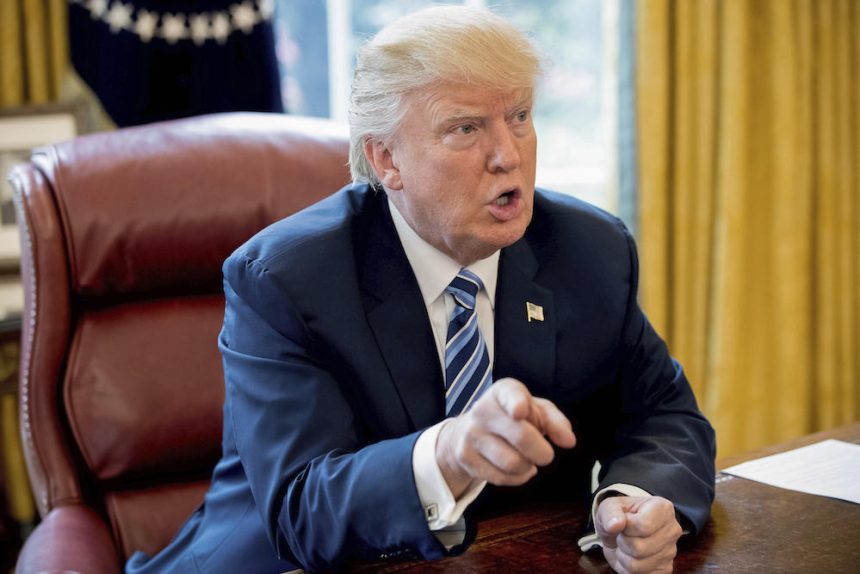
Breaking News: U.S. President Donald J. Trump Proposes Ambitious Plan for a Nuclear-Free World
In an unexpected and dramatic address delivered from the East Room of the White House earlier today, U.S. President Donald J. Trump unveiled what his administration is calling a “historic roadmap” toward the complete elimination of nuclear weapons worldwide. The proposal, labeled the Global Zero Initiative, marks the first time in modern history that an American president has laid out a comprehensive plan aimed not merely at reducing nuclear stockpiles but at abolishing them outright.
The announcement, which stunned observers across political, diplomatic, and military circles, presents a sweeping vision built on multilateral cooperation, unprecedented verification measures, and what the administration described as “strategic incentives” for nations that agree to dismantle existing arsenals. While reactions poured in almost immediately—ranging from cautious optimism to outright skepticism—the proposal has already sparked intense global debate about its feasibility, implications, and long-term consequences.
A Dramatic Opening Statement
Standing before a backdrop featuring American, Russian, Chinese, and United Nations flags, President Trump began with a message that blended idealism with characteristic assertiveness.
“Today,” he proclaimed, “we declare that the age of living under the shadow of total annihilation must end. The United States will lead the world toward a future where no child, anywhere, grows up fearing the flash of a nuclear blast.”
He went on to assert that while his administration has prioritized military strength, true strength “comes not just from power, but from the wisdom to prevent catastrophe.” Trump framed the proposal as a moral, strategic, and economic imperative, arguing that global stability, national security, and international prosperity would all benefit from the eventual abolition of nuclear weapons.
“It’s time,” he said, “for the world to move from mutually assured destruction to mutually assured survival.”
The Global Zero Initiative: Key Pillars
The administration released a 94-page outline detailing the steps envisioned under the Global Zero Initiative. Although the plan acknowledges the significant political and technical obstacles involved, it claims that through phased agreements and enforceable verification mechanisms, the world could achieve full nuclear disarmament by the mid-2040s.
The proposal revolves around five central pillars:
1. Immediate Freeze on Nuclear Expansion
All nuclear-armed states would commit to an immediate, independently verified freeze on the development, testing, or expansion of their arsenals. This includes suspension of nuclear modernization programs, a condition certain to draw scrutiny from defense analysts.
2. Multilateral Reduction Commitments
Within three years of signing, nuclear stockpiles would be reduced by 30 percent, with further reductions on a fixed five-year schedule. The administration argues that economic incentives—such as access to new trade agreements and reduced sanctions—would motivate participation.
3. Global Verification and Monitoring Agency
The plan calls for establishing a new international body, the Nuclear Verification and Security Agency (NVSA), endowed with inspection rights comparable to but more expansive than those of the International Atomic Energy Agency (IAEA). According to the administration, the NVSA would have authority to conduct surprise inspections, deploy remote sensing technologies, and coordinate intelligence-sharing among member states.
4. Comprehensive Defense Transition Programs
Recognizing that some nations rely heavily on nuclear deterrence for security, the plan proposes a series of defense transition agreements. These would involve the deployment of multinational peacekeeping forces, regional security treaties, and advanced missile-defense cooperation designed to reassure states that may fear vulnerability during the disarmament process.
5. Final Dismantlement and Repurposing
The final stage—slated to begin in the late 2030s—would involve the total dismantling of remaining warheads, closure of enrichment facilities, and conversion of nuclear-capable sites into civilian energy or research centers. The plan also envisions an international memorial to nuclear victims funded jointly by participating nations.
Domestic Reaction: Praise, Doubt, and Political Tension
At home, the proposal ignited a flurry of responses. Supporters hailed it as “visionary,” “bold,” and “potentially world-changing,” particularly among anti-nuclear advocacy groups and humanitarian organizations. One prominent peace-studies scholar described it as “the most ambitious nuclear policy proposal since the dawn of the atomic age.”
But skeptics—especially national-security analysts—warned that unilateral enthusiasm could create strategic vulnerabilities. Critics within the president’s own political coalition expressed concern that adversarial nations, especially those with opaque military programs, might exploit such an initiative.
A former Pentagon official commented, “Nuclear weapons have been the backbone of global deterrence for decades. Eliminating them sounds noble, but the risks of cheating, deception, and geopolitical instability are enormous.”
Some lawmakers questioned the practicality of enforcing the agreement, arguing that past treaties have struggled with verification challenges. Others worried that massive reductions in the American arsenal could embolden rival powers before equivalent commitments were secured.
The administration responded by emphasizing that the plan is strictly conditional and contingent on full participation by all nuclear-armed states. “The United States will not disarm alone,” a senior advisor stressed during a press briefing. “This is a collective endeavor.”
International Response: A Rapid Wave of Global Statements
Within hours of the announcement, world capitals issued statements that varied widely in tone.
Russia expressed cautious interest, noting that nuclear disarmament has long been part of its official rhetoric but emphasizing that any plan must respect “strategic parity.” Russian officials praised the spirit of the initiative but warned against “unrealistic expectations.”
China responded more ambiguously. Its foreign ministry welcomed “any effort that promotes global stability” but insisted that major powers maintain “mutual respect and trust”—a phrase analysts interpreted as a critique of U.S. alliances in the Indo-Pacific.
European nations, particularly Germany and France, were notably enthusiastic. Both governments issued statements supporting immediate multilateral talks, arguing that nuclear abolition aligns with longstanding European security priorities.
India and Pakistan, two nations whose nuclear competition remains tense, offered more reserved statements. India expressed willingness to “review the proposal,” while Pakistan stressed that regional security concerns must be addressed before reductions could be considered.
Meanwhile, North Korea, often one of the most difficult players in disarmament negotiations, dismissed the announcement as “political theater.” Still, analysts noted that Pyongyang’s response was less antagonistic than usual.
Experts Weigh In: Hope and Hard Realities
Diplomatic scholars noted that while the idea of complete nuclear elimination has been discussed for decades, the geopolitical landscape has rarely aligned in ways that make such a goal attainable. Many experts point to the complexities of trust, regional conflicts, and asymmetric power dynamics as major impediments.
A prominent arms-control expert stated, “Disarmament on this scale requires the highest level of transparency and cooperation. It’s extremely difficult, but not impossible. Political will is the deciding factor.”
Another analyst suggested that while the proposal may be aspirational, it could serve as a catalyst for renewed dialogue—even if total abolition remains distant.
“This kind of bold announcement can shift the global narrative,” she explained. “Even if the end-state is unreachable for now, intermediate steps could dramatically reduce global risk.”
A President Seeking Legacy
Observers have noted that the timing and framing of the proposal reflect an effort by President Trump to craft a long-term historical legacy. Throughout his address, he positioned himself as a transformational figure capable of reshaping global security norms.
“Future generations,” he said, “will remember this moment as the day the world chose peace over fear, cooperation over conflict, and life over destruction.”
Whether the Global Zero Initiative becomes a defining achievement or a fleeting diplomatic gesture remains to be seen. For now, it has thrust nuclear disarmament back into the spotlight, forcing governments, citizens, and policymakers to confront the stark reality of humanity’s most destructive weapons—and the possibility of a world without them.
What Comes Next
The administration has announced that it will convene a global summit in Geneva within the next 60 days, inviting all nuclear-armed states to begin preliminary discussions. The White House claims that several nations have already expressed interest in attending, though details remain unclear.
In the weeks ahead, diplomats and defense experts will analyze every clause of the proposal, debating the risks, opportunities, and trade-offs inherent in such a transformative vision. Whether this initiative becomes a landmark moment or a diplomatic footnote will depend on the willingness of rival nations to trust one another in ways they historically have not.
For now, the world watches closely. If the president’s proposal gains traction, it could fundamentally reshape international relations. If it falters, it will at least have reignited a crucial conversation—one that may shape global security for decades to come.
As the sun set over Washington, the administration emphasized that the journey toward a nuclear-free world would be long and uncertain. But for the first time in years, the idea is no longer merely theoretical. It is, at least for now, a topic on the global agenda..