

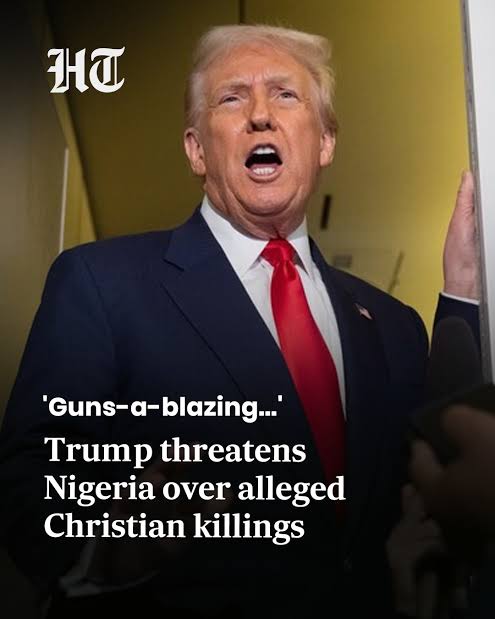
The statement that “Donald Trump has reportedly sent a warning to the Nigerian president regarding the killing of innocent Christian citizens” reflects a broader concern that has surfaced repeatedly in global discussions about religious freedom, human rights, and international diplomacy. Whether or not such a warning was officially issued, the idea itself highlights how issues within one nation can quickly draw the attention of influential political figures and international observers.
In this imagined or generalized context, the alleged warning from former U.S. President Donald Trump would center on accusations of violence targeted at Christian communities in Nigeria. Nigeria, a country known for its ethnic, religious, and regional diversity, has faced longstanding challenges involving communal conflicts, extremist violence, and localized disputes over land, resources, and identity. These issues are often complex and deeply rooted, but they often get simplified in international conversations, especially when framed by political leaders in other countries.
From Trump’s perspective—based on the kind of statements he often made while in office—such a warning would likely focus on religious liberty. Trump frequently spoke about the persecution of Christians globally, identifying it as an issue of great concern for both humanitarian and political reasons. In such a scenario, he might emphasize that the United States expects governments around the world, including Nigeria, to protect their citizens regardless of faith. He might also frame the issue as one that deserves urgent action to prevent further loss of life.
A message of this kind, if it had been communicated, would serve several purposes. First, it would signal to Nigeria that the international community is watching and expects accountability. Diplomatic pressure is often used to encourage governments to address internal problems, especially when those problems involve human rights. Second, it would communicate to Trump’s supporters—particularly Christian groups who closely follow issues of persecution—that he is attentive to their concerns even beyond U.S. borders. Third, such a warning could be interpreted as an attempt to influence Nigeria’s policies, pushing its leaders to intensify security measures, enhance religious protections, or investigate alleged abuses more thoroughly.
Nigeria’s leadership, in such a hypothetical situation, would respond cautiously. The Nigerian government usually rejects any oversimplified narratives about religiously motivated violence, often stating that the root causes are broader—related to economic hardship, land use conflicts, banditry, or terrorism. Officials frequently argue that violence in Nigeria affects all communities, not only Christians, and that portraying it as religiously one-sided can increase tension and misunderstanding. Therefore, they might respond to Trump’s alleged warning by reaffirming their commitment to protecting all citizens while also urging foreign leaders to avoid statements that might inflame local divisions.
At the same time, many Nigerians—both Christian and Muslim—might interpret such international attention in different ways. Some Christian groups would welcome external pressure if they feel that their suffering has been ignored or minimized. They might argue that high-profile global figures speaking out could draw more resources, investigations, and international support to affected regions. Others, however, might worry that foreign political statements could deepen preexisting fault lines within the country, potentially framing local conflicts in ways that do not reflect the lived reality of communities on the ground.
Analysts observing the situation would note that the United States, regardless of administration, has long taken an interest in Nigeria because of its population size, economic potential, and strategic importance in West Africa. Therefore, any strong statements from a former U.S. president—whether symbolic, political, or rhetorical—carry weight. Even unofficial remarks can spark debate and influence perceptions both inside and outside Nigeria.
Additionally, the issue of violence against civilians, whether Christians, Muslims, or other groups, is an ongoing challenge in parts of Nigeria. Human rights organizations often call for improved security, better intelligence coordination, and more decisive actions against extremist groups or criminal gangs. A warning from a foreign leader, real or hypothetical, would amplify these concerns but might not address the deeper structural factors fueling instability.
It is also important to recognize how statements from political figures can be used in different ways by media platforms. A phrase like “reportedly sent a warning” can circulate quickly, sometimes without clear verification. Supporters of Trump might highlight the statement as evidence of his commitment to protecting persecuted Christians. Critics might argue that such statements oversimplify complex issues or risk creating diplomatic friction. Nigerian media, on the other hand, might debate whether external criticism is justified or whether it infringes on national sovereignty.
Meanwhile, scholars of international relations would point out that diplomatic communication—whether formal or informal—plays a crucial role in shaping global expectations. Even symbolic warnings can pressure governments to act, even if no sanctions or policies accompany them. At the same time, such warnings must be balanced carefully to avoid undermining cooperation between nations that share economic, security, and cultural ties.
In conclusion, the statement that Donald Trump “reportedly sent a warning” to Nigeria’s president carries implications far beyond the sentence itself. It touches on themes of religious freedom, international diplomacy, political messaging, media interpretation, and the realities of violence affecting innocent civilians. Whether seen as advocacy, interference, or global concern, the idea underscores the interconnectedness of today’s world—where internal problems within a country often draw the attention of influential voices abroad. It also highlights the importance of approaching sensitive issues with nuance, accuracy, and an understanding of the broader historical and political context.